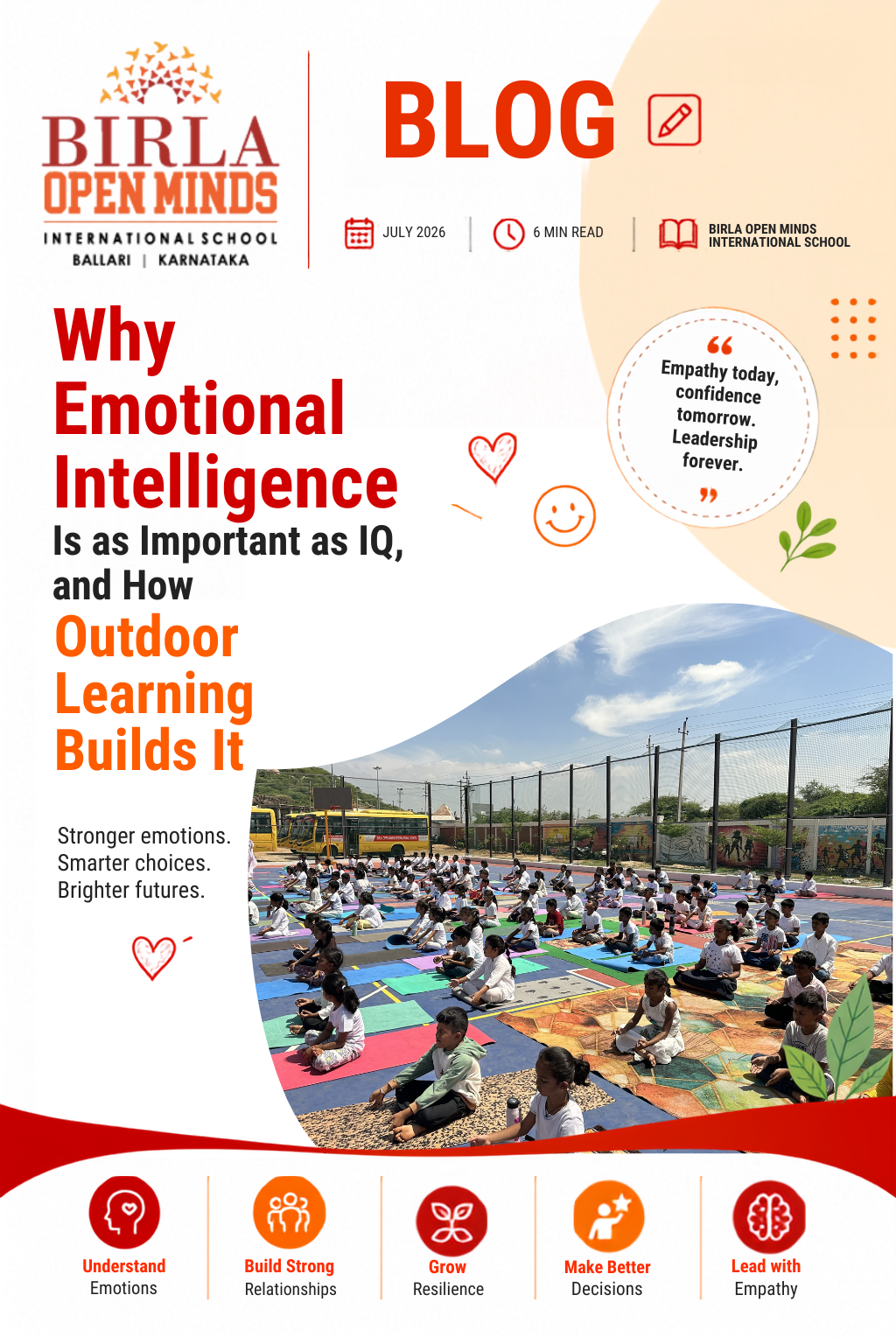
Why Emotional Intelligence Is as Important as IQ, and How Outdoor Learning Builds It
For decades, a high IQ was treated as the clearest predictor of a child's future success. Report cards, entrance tests, and dinner-table comparisons all pointed to one number. But raising a child who thrives, at school, with friends, and later at work, takes more than the ability to solve equations or memorise facts. It takes emotional intelligence, often called EQ: the ability to recognise, understand, and manage emotions in oneself and in others.
At Birla Open Minds International School, Ballari, our curriculum is built on the understanding that a child's social, emotional, spiritual, physical, motor, and cognitive development all need equal attention for a truly holistic start. This article looks at why EQ deserves a seat at the table next to IQ, and why time spent outdoors is one of the most effective, and most overlooked, ways to build it.
What Is Emotional Intelligence, and Why Does It Rival IQ?
Psychologists Peter Salovey and John Mayer, whose work was later popularised by Daniel Goleman, describe emotional intelligence as the capacity to monitor one's own and others' feelings, tell them apart, and use that understanding to guide thinking and behaviour. Unlike IQ, which is largely fixed, EQ can be actively taught and strengthened throughout childhood.
Five abilities make up a child's emotional intelligence:
- Self-awareness: naming and recognising one's own emotions as they arise
- Self-regulation: managing big feelings without being overwhelmed by them
- Motivation: channelling emotion towards goals rather than giving up
- Empathy: reading and understanding what others are feeling
- Social skills: building relationships, resolving conflict, and working well in a group
What the Research Says
According to the National Association for the Education of Young Children (NAEYC), children with stronger emotional intelligence pay attention better, stay more engaged in school, form more positive relationships, and show greater empathy. Emotions shape attention, memory, and learning, so a child who cannot yet manage frustration or anxiety will struggle to access their full cognitive ability, however high their IQ.
Later research adds more detail. A 2023 meta-analysis from the University of Zaragoza found emotional intelligence to be a consistent predictor of academic performance across age groups. Other studies link stronger EQ in children to fewer behavioural issues, better problem-solving, and greater resilience under stress. In short, EQ does not compete with IQ, it determines how much of that IQ a child is actually able to use.
The Benefits of Outdoor Learning
If emotional intelligence has to be practised to grow, the outdoors turns out to be one of the best places to practise it. A growing body of research on nature-based and outdoor education points to consistent benefits across physical, cognitive, and social-emotional development:
- Sharper attention and focus: studies following preschoolers found that more time spent outdoors was linked to better memory and attention, and fewer signs of inattention, years later
- Lower stress: school days that include outdoor learning have been associated with lower stress hormone levels and better stress regulation in students
- Stronger social-emotional skills: nature-based learning settings have been linked to gains in literacy, social-emotional development, and overall wellbeing
- Better physical health: children who spend more time in green outdoor spaces show higher activity levels and lower risk of obesity
- More independence and confidence: unstructured outdoor play builds decision-making, initiative, self-discipline, and empathy towards others
How BOMIS Ballari Brings Emotional Intelligence and Outdoor Learning Together
This is exactly why our approach at BOMIS Ballari does not stop at the classroom door. Our curriculum, developed under the guidance of Birla Edutech, is designed so that social and emotional growth happen alongside academics rather than after them.
- Spacious outdoor play areas: our playground gives children room for sports, unstructured play, and the kind of peer negotiation that builds real social skills
- Dedicated activity rooms: purpose-built spaces for creative and physical activity give every child a safe space to explore and socialise
- Small, well-trained classrooms: our certified educators are trained to notice and respond to a child's emotional needs, not just their academic ones
- A safe, supervised campus: round-the-clock CCTV surveillance means children can be given the freedom to explore outdoors within a secure environment
- Regular parent updates: consistent communication keeps families informed of both academic and social-emotional progress, not just report cards
Practical Ways Parents Can Build Emotional Intelligence at Home
- Name the feeling: help your child put a word to what they are feeling instead of only reacting to the behaviour
- Model calm responses: children learn regulation by watching how the adults around them handle frustration
- Ask, don't lecture: “How do you think your friend felt?” builds empathy far better than being told the answer
- Protect unstructured outdoor time: a walk, the garden, or free play at the park all count, screen-free time outdoors does not need to be a lesson to be valuable
- Praise effort, not just results: this builds the motivation and resilience that EQ depends on
Frequently Asked Questions
Is emotional intelligence more important than IQ? Not more important, but equally important. IQ reflects cognitive ability, while EQ determines how well a child can apply that ability at school, with friends, and later at work. Children need both to thrive.
At what age should emotional intelligence be developed? Early childhood is considered the most effective window, since the emotional and social habits formed between the toddler years and age eight tend to carry into adolescence and adulthood.
How much outdoor time do children need for these benefits? There is no single fixed number, but research consistently associates regular, repeated time outdoors, ideally daily, with better attention, lower stress, and stronger social-emotional skills than occasional or one-off outdoor sessions.
Does outdoor learning replace classroom academics? No. Outdoor learning is most effective as a complement to classroom instruction, not a substitute for it, giving children a different context to practise focus, regulation, and teamwork.