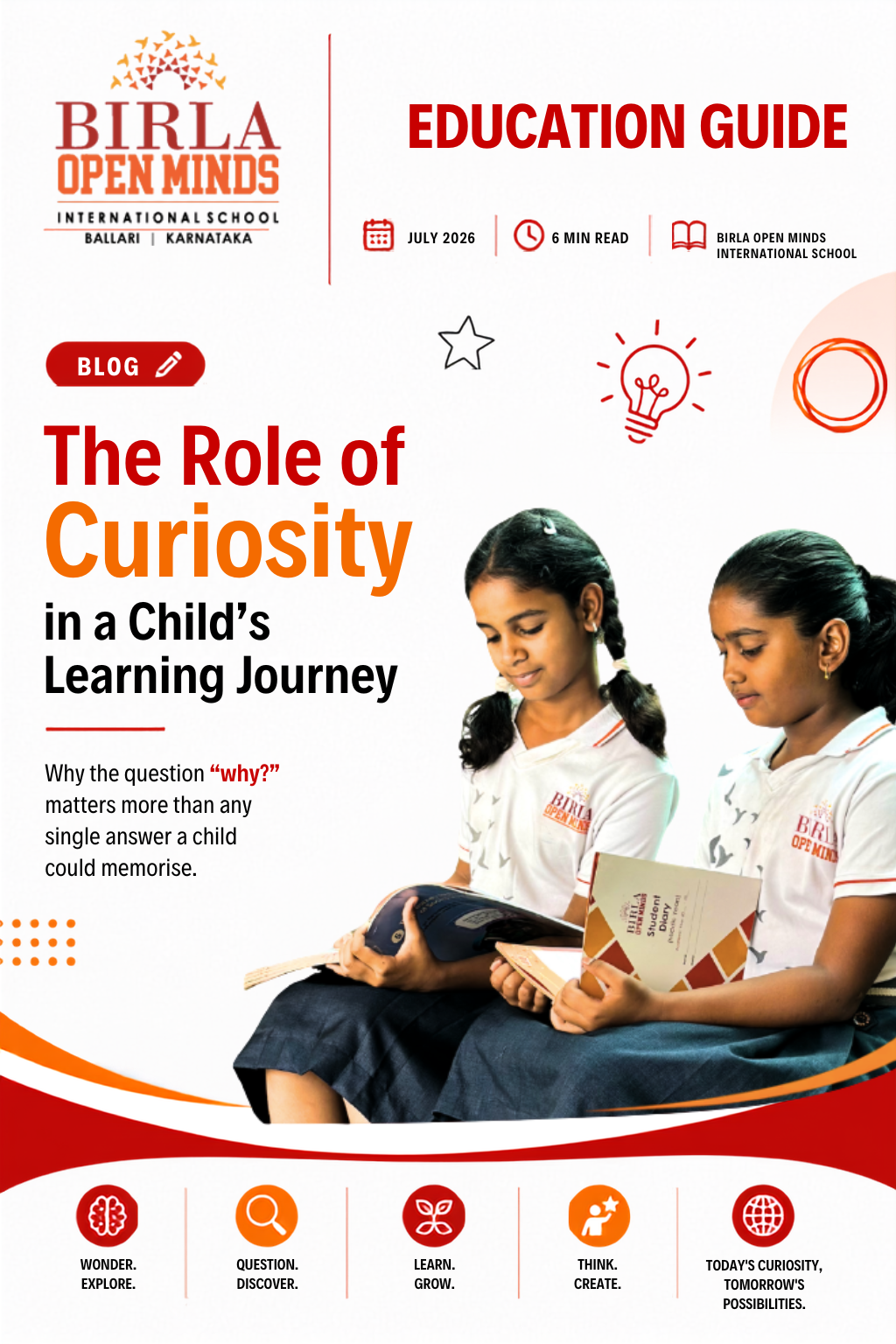
The Role of Curiosity in a Child's Learning Journey
Why the question “why?” matters more than any single answer a child could memorise.
Every parent knows the moment: a child crouches over an ant trail, pokes at a puddle, or asks “but why is the sky blue?” for the fifth time in an hour. It can feel like a distraction from “real” learning. In truth, it is the opposite: curiosity is the engine that drives real learning, and nurturing it early is one of the most powerful gifts a parent or school can offer a child.
At Birla Open Minds International School (BOMIS), Ballari, we design every classroom experience around a simple belief: children do not learn best when they are told what to think. They learn best when they are given room to wonder, explore, and ask their own questions, with caring adults guiding them along the way.
Why Curiosity Matters More Than Rote Memory
For decades, traditional schooling rewarded the child who could recall the most facts the fastest. But the world our children will grow up in does not run on memorised facts alone; it runs on the ability to ask good questions, adapt, and keep learning long after school ends.
Research in child development consistently shows that curiosity-driven learning activates deeper cognitive engagement than passive instruction. When a child is genuinely curious about something, they retain it longer, connect it to other ideas more easily, and are more motivated to keep exploring the topic on their own.
Four Ways Curiosity Shapes a Child's Development
- Stronger memory and understanding: Concepts explored through a child's own questions stick far better than facts delivered through lecture alone.
- Confidence and independence: A child who is encouraged to ask “why” learns that their thinking has value, building self-belief early.
- Better problem-solving: Curious children are more comfortable sitting with an unanswered question, a skill essential for maths, science, and everyday life.
- Lifelong love of learning: Children praised for curiosity, not just correct answers, tend to stay engaged learners well beyond the classroom.
How BOMIS Ballari Nurtures Curiosity in the Classroom
Curiosity does not grow in a vacuum; it needs the right environment. At BOMIS Ballari, our classrooms and programmes are deliberately designed to keep that spark alive at every age:
Pre-School (18 Months – 5 Years)
Play-based learning encourages toddlers and young children to touch, build, and question the world around them, long before formal instruction begins.
Primary School (6 – 10 Years)
Smart classrooms and hands-on activities turn every subject, from science to storytelling, into an open invitation to explore rather than a fixed set of answers to memorise.
Middle School (10 – 14 Years)
Project-based tasks, labs, and discussion-driven lessons push students to ask deeper “what if” questions and connect classroom concepts to the world outside.
“Curiosity is the wick in the candle of learning. Our role as educators is simply to protect that flame long enough for a child to carry it themselves.”
Simple Ways Parents Can Nurture Curiosity at Home
Schools play a vital role, but curiosity is built at home too, in the everyday moments between drop-off and bedtime. A few practical habits parents in Ballari can start today:
- Answer questions with questions: When your child asks “why?”, try “what do you think?” before giving the answer.
- Make room for boredom: Unstructured time is often when children invent their most creative questions and games.
- Follow their lead: If your child is fascinated by dinosaurs, insects, or the moon, follow that thread instead of redirecting them to a “more useful” topic.
- Model curiosity yourself: Children who see parents wondering aloud and looking things up learn that curiosity does not stop at any age.
- Celebrate the question, not just the answer: Praise effort and inquisitiveness, not only correct results.
Curiosity and Long-Term Academic Success
Parents often ask whether a curiosity-first approach comes at the cost of academic rigour. The evidence says the opposite. Children who are encouraged to explore concepts through curiosity tend to develop stronger conceptual foundations, which serve them well later in structured, exam-oriented stages of schooling, including board examinations and competitive assessments.
This is why, at BOMIS Ballari, curiosity-led learning in the early years is not separate from academic preparation; it is the foundation for it. A child who has learned to ask good questions at age six is far better equipped to tackle complex problem-solving at age fourteen, and beyond.
A Checklist: Is Your Child's Learning Environment Curiosity-Friendly?
- Are children encouraged to ask questions, even ones without easy answers?
- Do teachers respond to curiosity with encouragement rather than correction alone?
- Is there room in the daily schedule for open-ended exploration, not just fixed lessons?
- Are mistakes treated as part of discovery rather than failure?
- Does the school communicate regularly with parents about how curiosity is nurtured at home and in class?
Common Myths About Curiosity-Led Learning
Myth 1: “Curiosity is a distraction from the syllabus.”
In reality, a curious child covers the syllabus more deeply, not less. Questions that arise naturally from a lesson almost always lead back to the core concept, just with far stronger retention than passive listening ever could.
Myth 2: “Some children are simply more curious than others.”
Every child is born curious: watch any toddler explore a new room. What differs is whether that curiosity is nurtured or gradually discouraged by rigid routines, rushed answers, or fear of asking a “silly” question.
Myth 3: “Curiosity cannot be measured, so it cannot be taught.”
While curiosity itself is hard to grade, its ingredients: asking questions, exploring alternatives, seeking out new information, can absolutely be modelled, encouraged, and built into daily classroom habits.
Frequently Asked Questions
At what age should curiosity-led learning begin?
As early as possible. Even 18-month-olds benefit from play-based exploration that lets them investigate textures, sounds, and cause-and-effect at their own pace.
Does curiosity-led learning work for exam-focused boards like CBSE?
Yes. A strong conceptual foundation built through curiosity in the early years directly supports the deeper problem-solving skills that board examinations and competitive exams eventually demand.
What can teachers do differently, starting tomorrow?
Something as simple as pausing after a question, giving a child ten extra seconds to think before offering the answer, can noticeably shift a classroom from passive listening toward active curiosity.
Final Word: Raising Lifelong Learners, One Question at a Time
The most important thing a school can teach a child is not any single fact; it is how to keep wanting to learn. Curiosity, nurtured consistently from the earliest years, gives children the confidence to explore, the resilience to sit with hard questions, and the motivation to keep growing long after they leave the classroom.
At Birla Open Minds International School, Ballari, under the guidance of Birla Edutech Limited, we are committed to keeping that spark of curiosity alive: one question, one classroom, one child at a time.