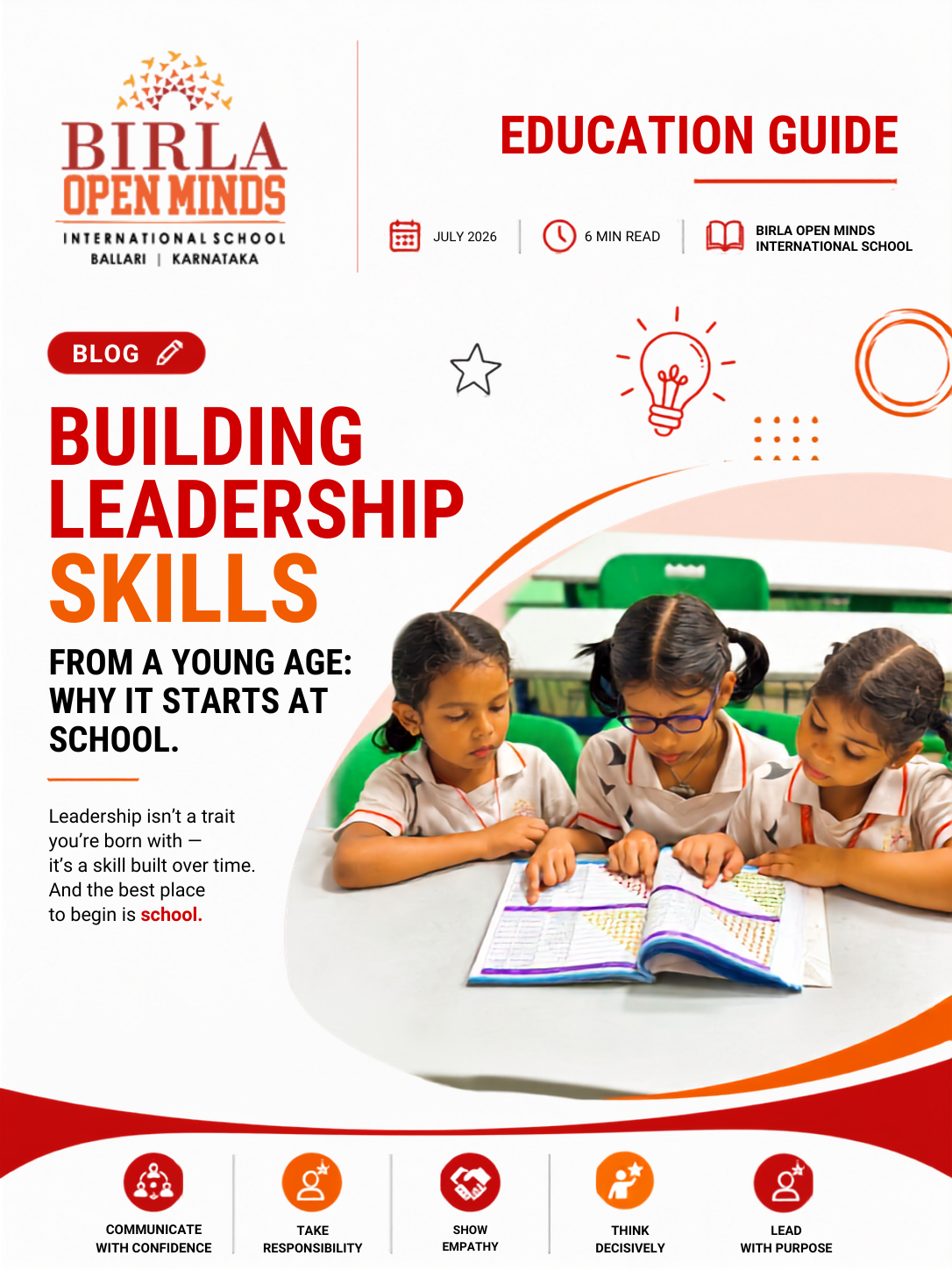
Building Leadership Skills from a Young Age: Why It Starts at School
Meta Title: Building Leadership Skills from a Young Age | BOMIS Ballari
Meta Description: Leadership isn't a trait you're born with, it's a skill built over time. Discover why schools play a critical role in developing young leaders, and how to nurture these qualities early.
Focus Keyword: building leadership skills from a young age
Secondary Keywords: leadership skills for students, how to develop leadership in children, student leadership development, BOMIS Ballari school
Introduction: Leaders Are Made, Not Born
There is a persistent myth about leadership, that some people simply have it and others don't. That a child is either naturally confident, naturally decisive, naturally inspiring, or they're not.
The reality, backed by decades of educational research, is far more encouraging. Leadership is a skill, not a personality trait. And like every meaningful skill (reading, mathematics, critical thinking), it is most effectively developed when introduced early, practised consistently, and nurtured in the right environment.
For parents and educators, this is both a responsibility and an opportunity. The habits, mindsets, and interpersonal skills that define great leaders in adulthood are being formed right now, in classrooms, on playgrounds, and in the everyday moments of school life.
1. What Does Leadership Actually Mean for a Young Person?
Before talking about how to build leadership skills, it's worth getting specific about what those skills actually look like in children and adolescents, because leadership in young people looks very different from the boardroom version most adults picture.
For a child, leadership shows up as the confidence to speak up in class when they hold an unpopular opinion. It shows up as the ability to listen to a classmate's idea without dismissing it. It shows up as taking responsibility when a group project goes wrong rather than pointing fingers. It shows up as the willingness to try, fail, learn, and try again without losing self-belief.
These are not grand gestures. They are daily habits. And they are exactly what schools, at their best, are designed to cultivate.
2. Why Early Development Matters
The case for building leadership skills early is both neurological and practical.
From a brain development perspective, the years between ages six and sixteen are a critical window for developing the prefrontal cortex, the region responsible for decision-making, impulse control, empathy, and long-term thinking. These are, not coincidentally, the same cognitive functions that underpin effective leadership. Experiences and habits formed during this window have a lasting influence on how a young person navigates challenge, conflict, and responsibility throughout their life.
From a practical standpoint, children who develop leadership habits early simply have more time to practise them. A student who learns how to facilitate a group discussion at age ten will have six more years of school to refine that skill before entering college or the workforce. Compare that to a student who encounters leadership development for the first time in a corporate training programme at age twenty-five. The gap in foundation is enormous.
3. The Core Leadership Skills Schools Should Be Building
Not all leadership qualities develop naturally without intentional effort. The most important ones to actively cultivate in young students include:
Communication and articulation. The ability to express ideas clearly, listen actively, and adapt how you communicate to different audiences. This includes public speaking, but also the quieter skills: asking good questions, giving constructive feedback, and knowing when to say nothing at all.
Responsibility and accountability. Leadership begins with owning your actions and their consequences. Schools that give students real responsibilities, such as prefect roles, project leadership, and event organisation, teach this far more effectively than any classroom lesson about it.
Empathy and emotional intelligence. The most effective leaders understand the people around them. Schools that make space for emotional literacy, conflict resolution, and collaborative problem-solving are building this capacity in their students, often without labelling it as leadership development.
Resilience and a growth mindset. Leadership inevitably involves setbacks, criticism, and failure. Students who learn early that failure is information rather than a verdict on their worth develop the psychological resilience that allows them to keep going when things get hard.
Decision-making under uncertainty. Real leadership rarely involves perfect information. Activities like debates, model UN, student councils, and even sports require young people to make calls with incomplete information and defend those decisions, exactly the muscle that great leaders rely on daily.
4. How Schools Can Actively Develop Young Leaders
Curriculum alone is not enough. Leadership development requires deliberate structures built into school life.
Student councils and leadership roles give students genuine agency over real decisions affecting their community, not symbolic participation, but meaningful responsibility with visible consequences. When a student-led initiative improves the school environment, that experience of effective action is formative.
Project-based and collaborative learning moves students out of passive absorption and into active problem-solving together. Working on a team toward a shared goal, managing disagreements, dividing responsibilities, and delivering results, is leadership training in its purest form.
Sports and co-curricular activities teach leadership in ways the classroom cannot replicate. The athlete who motivates a teammate after a loss, the debate captain who holds a team together through a difficult tournament, the school play director who coordinates dozens of moving parts, these are leadership experiences that leave deep impressions.
Mentorship and role modelling from teachers and senior students provide young people with a visible picture of what leadership looks like in practice. Students who are seen, encouraged, and given genuine trust by the adults around them rise to meet that trust far more often than not.
5. The Role of Parents Alongside Schools
Schools do not operate in isolation. The habits and values a child encounters at home either reinforce or undermine what is built in the classroom.
Parents who give children age-appropriate responsibilities at home, who model how to handle disagreement respectfully, who allow children to experience natural consequences rather than rescuing them from every difficulty, and who celebrate effort and growth over performance and grades: these parents are building the same leadership foundations that the best schools are trying to cultivate.
The most powerful outcomes happen when school and home are working toward the same vision of the kind of person a child is becoming.
BOMIS Ballari: Where Young Leaders Are Built Every Day
At BOMIS Ballari, leadership development is not an afterthought: it is woven into every aspect of school life. From student council participation and inter-school competitions to project-based learning and value-centred education, BOMIS provides students with the opportunities, guidance, and environment to discover and grow their leadership potential from a young age.
Every child who walks through our doors carries the potential to lead, in their classroom, their community, and eventually the world beyond. Our role is to make sure they have every chance to find that potential and build it into something lasting.
Enrol your child at BOMIS Ballari and give them the foundation that will serve them for life, not just academically, but as confident, compassionate, and capable leaders of tomorrow.
Frequently Asked Questions
Q1. At what age should leadership skills development begin?
Leadership skills can begin developing as early as age five or six through simple responsibilities and collaborative play. The primary and middle school years, roughly ages six to fourteen, are particularly formative, as this is when habits of communication, empathy, and responsibility are most naturally cultivated.
Q2. Can leadership skills be taught, or are some children just natural leaders?
Leadership skills are absolutely teachable. While some children may be naturally more extroverted or assertive, the core qualities of effective leadership, empathy, decision-making, accountability, and resilience, are developed through experience, practice, and guidance, not fixed personality traits.
Q3. How do schools like BOMIS Ballari develop leadership in students?
BOMIS Ballari integrates leadership development through student council roles, project-based collaborative learning, sports and co-curricular activities, inter-school events, and a value-centred educational culture that encourages responsibility, initiative, and mutual respect.
Q4. Is leadership development only relevant for academically strong students?
Not at all. Leadership potential exists across every kind of student. A child who struggles with academics may show extraordinary leadership in sports, arts, or peer dynamics. Good schools recognise and develop leadership potential in every student, not just those at the top of the academic rankings.
Q5. How can parents support leadership development at home?
Giving children age-appropriate responsibilities, allowing them to experience the natural consequences of their choices, modelling respectful disagreement, and praising effort and growth over results are among the most effective ways parents can reinforce leadership development at home.